Great news! On Friday Richard has successfully defended his PhD thesis 🙂 We were all very happy and wish Richard all the best in his future postdoc at Tufts! A couple of papers from his thesis work on micromonas will be submitted later this year 🙂
PhD and PDRA opening for biophysics of phototaxis
Currently seeking a PhD student  (UK/EU) and a PDRA (any nationality) to work on an exciting new international and interdisciplinary project exploring the link between light-induced motility and photosynthesis in microalgae.
The project is generously funded by The Leverhulme Trust, and is a collaboration with Idan Tuval (IMEDEA, Mallorca Spain) and Dimitris Petroutsos (CEA, Grenoble France). It will involve extensive travelling between the partners (all costs covered)!
Apply here or here for the PhD, and here for the PDRA. Starting date Sept 2019 (potentially flexibility). Project duration 3.5y.
For more informations, feel free to contact Marco.
Richard lands US postdoc!
Great news! Richard has been offered a postdoctoral position by Jeff Guasto at the Department of Mechanical Engineering at Tufts University! Well done Richard!
In Phase or Out of Phase, that is the question
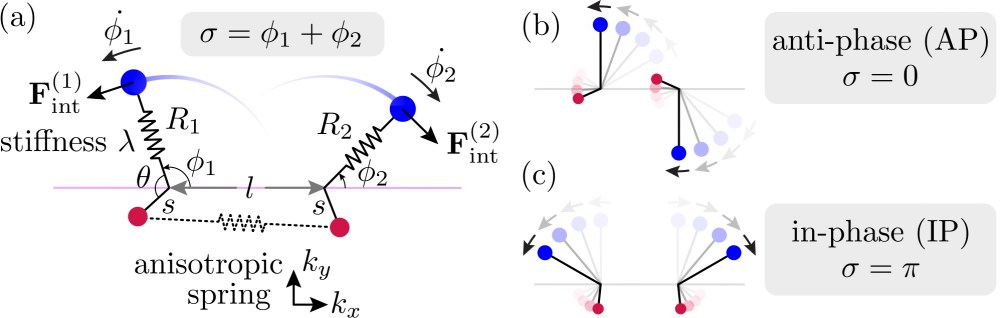
How do cilia synchronise? Through hydrodynamics? Elasticity? Intracellular coupling? The mechanism seems to depend on whether these oscillators belong to same cell or not. In the latter case, we have shown that hydrodynamic interactions suffice; in the former, however, direct intracellular coupling between the flagella is necessary (see here, here, and here). How is this coupling acting? How can it promote opposite types of synchronisation? Our idea is that synchronisation states depend on the cell actively stiffening/relaxing the internal fibres joining the ciliary basal bodies. We explore this hypothesis in our new paper, recently accepted in J. Roy. Soc. Interface, looking at a  minimal model of “cilia coupled by intracellular connections”. (ArXiv preprint. Full version and Supplementary Informations including animations). A big Thank to U. Melbourne and its Department of Mathematics and Statistics for hosting Marco during the final developments of this work!!
Fluids CDT Summer School @ Imperial
Last week I gave a couple of lectures at the Fluids CDT Summer School, organised by Eric Keaveny and Chiu Fan Lee. It was great fun (for me, at least), and I would have liked to be able to stay more than just one day… In any event, if you’re interested, you can find a PDF of my presentation on bacterial and eukaryotic motility (…as in swimming) here and here. Enjoy! …and please let me know your thoughts/comments!
Cheltenham Science Festival
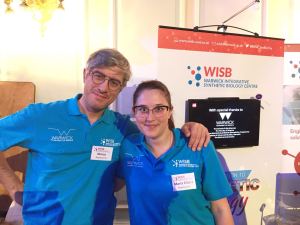
Great day last Saturday! Our little contingent from Warwick Physics (Maria Chiara Roffin, Max Meissner, and myself) helped manning the WISB stand at the Cheltenham Science Festival. It was great fun, and a good chance to promote science to the general public!
URSS funding for Javiera
Javiera Leemhuis, 3rd year undergraduate in Physics at Warwick, was awarded a £1000 URSS bursary for a 10-weeks URSS project this summer in collaboration with me and Kela Lushi, looking at the behaviour of microswimmers in complex confinement. Well done Javiera!
Pilot Project from Network Plus
We’re delighted to share the news that we have received travel funds from the EPSRC Network Plus Emergence and Physics Far From Equilibrium to kickstart a collaboration with the groups of Dr. Giorgio Volpe (UCL, UK), Dr. Nuno Araújo (U. Lisbon, Portugal) and Dr. Idan Tuval (IMEDEA-UIB, Spain). The project, which will start later this year, focusses on understanding and controlling transport properties of binary suspensions where microscopic active particles interact with passive ones (cargoes).
Microparticle entrainment à la Taylor
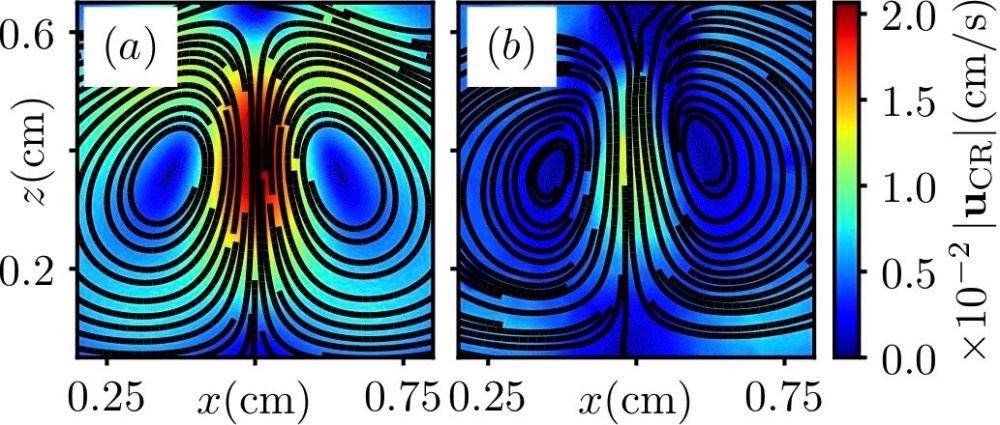
Close contact between microorganisms underpins fundamental interactions including infection, microbial grazing and fertilisation, but whether or not these interactions actually happen depends critically on the duration of contact. For swimming microorganisms, prolonged contact with an object should manifest as entrainment, and its extend hinge on the physics of escape from the entrained state. At present, neither the existence of entrainment nor the physical mechanisms determining its duration are well established. In our new paper, published in Physical Review Fluids, we combine experiments and theory to show that particle entrainment is indeed a generic feature of swimming microorganisms, and that its duration depends on an interplay between advection and diffusion. A Taylor-dispersion-type theory rationalises the dependence of the distribution of contact times on swimmers’ parameters, and predicts an optimal size for entrainment (~1μm), which we confirm experimentally. [ArXiv Preprint]
Albert Shimmins International Fellowship
Great news! Together with my friend (and host) Douglas Brumley, we have been awarded an Albert Shimmins International Fellowship from the University of Melbourne  (AUD 15k) to help fund my 2-months visit to the Mathematics Department in Melbourne!