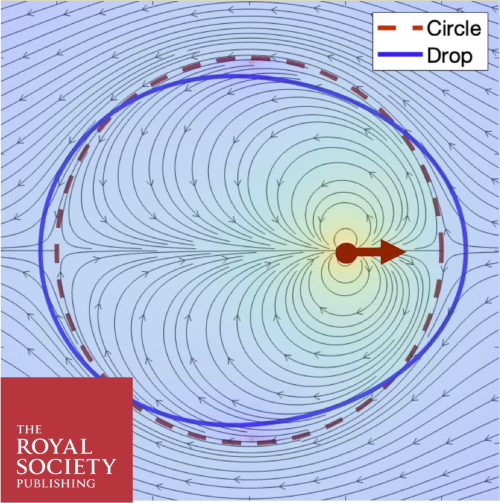
An active-passive system is composed of an ensemble of active out-of equilibrium agents, interacting with passive ones. This could be the interior of a cell, with molecular motors creating flows which transport passive (as in: non-active) material; or it could be non-motile bacteria buffeted around by motile ones (see also bacterial hitchhiking!). In all of these cases, the active “bath” changes significantly the stochastic properties of the passive components. Together with Horacio Serna, Miguel Barriuso, Ignacio Pagonabarraga and Chantal Valeriani, we studied one example of these properties, where activity leads to an enhanced sorting of the system. The paper is out now on Soft Matter and we also got one of the two issue covers!
Research
Separating cilia with a oh-so-thin blade
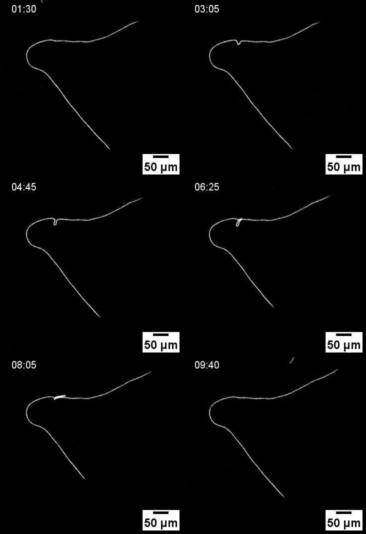
Multiple beating cilia need some form of coupling to synchronise. In groups of cells, hydrodynamic coupling can be enough… but for single cells, it seems to be essential to have internal mechanical connections. In this case, does hydrodynamics play any role at all? In a new paper, just out in Physical Review Letters (Editors’ Suggestion!), we use a tip-less AFM cantilever (sub-micron thin!) to block hydrodynamic coupling between the two flagella of a single Chlamydomonas cell. The results highlight a striking difference between wild type, with its two different flagella, and the flagellar dominance mutant ptx1. This work was spearheaded by Luc Zorrilla (who’s just defended his thesis!), in collaboration with Antoine Allard (LOMA, U. Bordeaux) and Krish Desai (former MPhys student, Physics Department, U. Warwick).
Biological fluid dynamics:emerging directions
We are happy to announce the publication of a special issue “Biological fluid dynamics: emerging directions” in Philosophical Transactions of the Royal Society A. The special issue, which presents contributions at the cutting edge of research biological fluid dynamics, crowns the epilogue of the (first?) Biological Fluid Dynamics Special Interest Group of the UK Fluids Network. It was co-edited by Marco, together with Dave Smith (U. Birmingham, UK), Smitha Maretvadakethope (Imperial College London, UK) and Laurence Wilson (U. York, UK). It has been an absolute privilege to work with Dave, Smitha and Laurence on this, and we were excellently supported by the editorial staff of Royal Society Publishing. I hope the issue will be of interest not only to the biofluids community but also to the many other scientific communities that intersect this vibrant interdisciplinary area. I wish you all a good read!
Reversals and plectonemes in gliding cyanos
Cyanobacteria are ubiquitous photosynthetic microorganisms producing oxygen for approximately every fifth breath we take. Many live in filaments that can reach hundreds of cells and these filaments can coordinate to glide and even reverse direction. Direction reversal requires a sufficient number of cells to coordinate and start pushing in the opposite direction, a mechanism that is not well understood. In a new study just published on eLife we look into these coordinated reversals (experiments and modelling) and show that failure to coordinate leads to the formation of plectonemes (well known to whoever has had a tangled telephone cable…). This work was the result of a collaboration with the groups of our friends Orkun Soyer (who lead the study; U. Warwick), Chantal Valeriani (U. Complutense) and Emanuele Locatelli (U. Padova).
Synchronised growth oscillations in fungi
We had the pleasure to collaborate with the groups of Munehiro Asally and Orkun Soyer on investigating the long-term growth dynamics of hyphae of S. indica, a root-colonising fungus (…sounds scary but it’s good). We were all surprised when it turned out that the growth of the different hyphae synchronises in system-wide oscillations lasting many hours. Want to know more? The paper, led by Praneet Prakash, has just been published by the Journal of the Royal Society Interface. You can read it here!
Predicting seasonal spawning of fish
We had fun helping our friends from MARES at IMEDEA on their quest to better understand the dynamics of fish spawning. The data available are sea surface temperature, fishery-dependent sampling and the gonadosomatic index of the captured fish. The result, published in Marine Environmental Research, is an experimentally validated model that allows one to predict the timing of spawning peak in a population of wild fish and its dependence on temperature variations. It’s cool to think that this could help improve the management of fisheries and make it more sustainable. Thanks to our friends Vincenç, Miquel, Andrés and Ignacio for involving us in the project!
Tracking with multiple legs
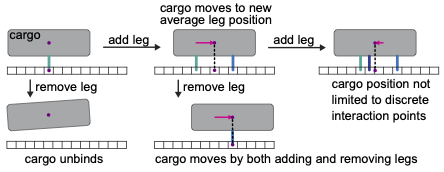
How do you move on a substrate if you have many “legs”? Together with Lewis Mosby and Anne Straube we have explored this problem in a paper just accepted on the Journal of Royal Society Interface (link; a version of this work is also available on the arXiv). Turns out that the spatial variation of binding rates can make you surf fast enough to follow the polymerisation of the substrate… all captured analytically!
Bacterial swarms thicken up

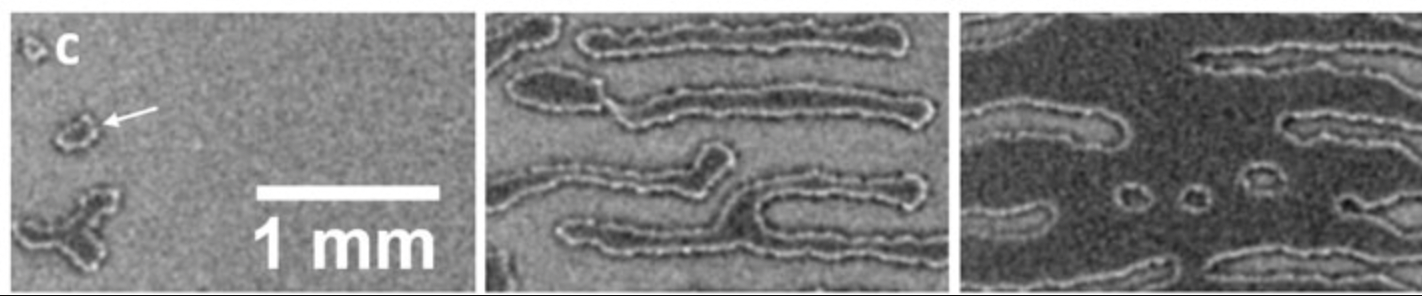
New paper out on B. subtilis swarming dynamics! The paper, published in Frontiers of Soft Matter, is a collaboration with Iago and Munehiro and builds on our previous paper on eLife. Here we dwell into the characterisation of the transition from a monolayer to a multilayer swarm. Turns out that this looks like a first order phase transition and can take either a “nucleation and growth” route or a more sudden “spinodal” decomposition route…
The curious case of confined active-passive systems

We’re excited to share our latest publication in Nature Communications, where we investigate the dynamics of mixed active-passive systems. In these systems, the passive particles are buffeted around by the active components like swimming microorganisms or synthetic active particles. These suspensions are fascinating both at a fundamental level (how can we describe/prescribe the average behaviour of the passive particles?) and -possibly- for future technological applications (directed transport at the microscopic scale). Here we show that confining an active-passive system leads to a non-uniform distribution of the passive species in a predictable way. We then use confinement to induce the mixed system to spontaneously un-mix and separate out the passive components! This is Steve’s first paper, in collaboration with Raphaël Jeanneret (LPENS Paris, France) and Idan Tuval (IMEDEA UIB-CSIC, Spain).
The Narrow-Escape of a Microorganism
Escaping through narrow apertures involves rare events and therefore is usually quite hard. It is also a classical problem for both Brownian and ballistic particles. Interestingly, microorganisms can find themselves having to find and go through a narrow aperture. Their case is peculiar as it bridges the Brownian and ballistic cases. Our new paper, just out in Physical Review Research, looks at this problem with a mix of experiments and simulations. As is often the case, we find an unexpected twist in the story…. A great collaboration with Antoine Allard, Mathieu Souzy, Jean François Louf, Matteo Contino and Idan Tuval.