There is a new opening for a Ph.D. student in the group, to work on movement of microorganisms in response to light. The plan is for this project to kickstart a collaboration with the group of Giovanni Finazzi, at CEA Grenoble (Fr.). More informations can be found here. If you’re interested or know outstanding students that might be interested, do not hesitate to contact Marco! Funding is for UK students or outstanding EU (continental) students only.
Author: mpolin
New Office!
 On a light note, today Raphael and Matteo took possession of their new office, which is now groundfloor in the Physics main building. As you can see, the whiteboard in the office was the vehicle of choice to express the excitement of finally running their own kingdom! 😉
SynBio Teaser Week: how it happened (take 2)
 Today we
 had the second microfluidics half-day for the SynBio students. We really enjoyed our time with them, and hope they enjoyed it too. Thanks to our “training” yesterday, we were able to speed up things a bit, with the result that the students managed to extract tracks of swimming microalgae from their movies (this is a step further than just recognising the position of microorganisms in individual frames).
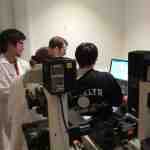 Three extra guests joined the students: Munehiro Asally, a newly
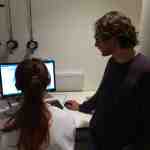 recruited Assistant Professor in Life Sciences here at Warwick; Paul MacDonald, a new Ph.D. student of Alfonso Jaramillo; and Christopher de Wolf, a technician/researcher from Orkun Soyer’s lab.
SynBio Teaser Week: how it happened
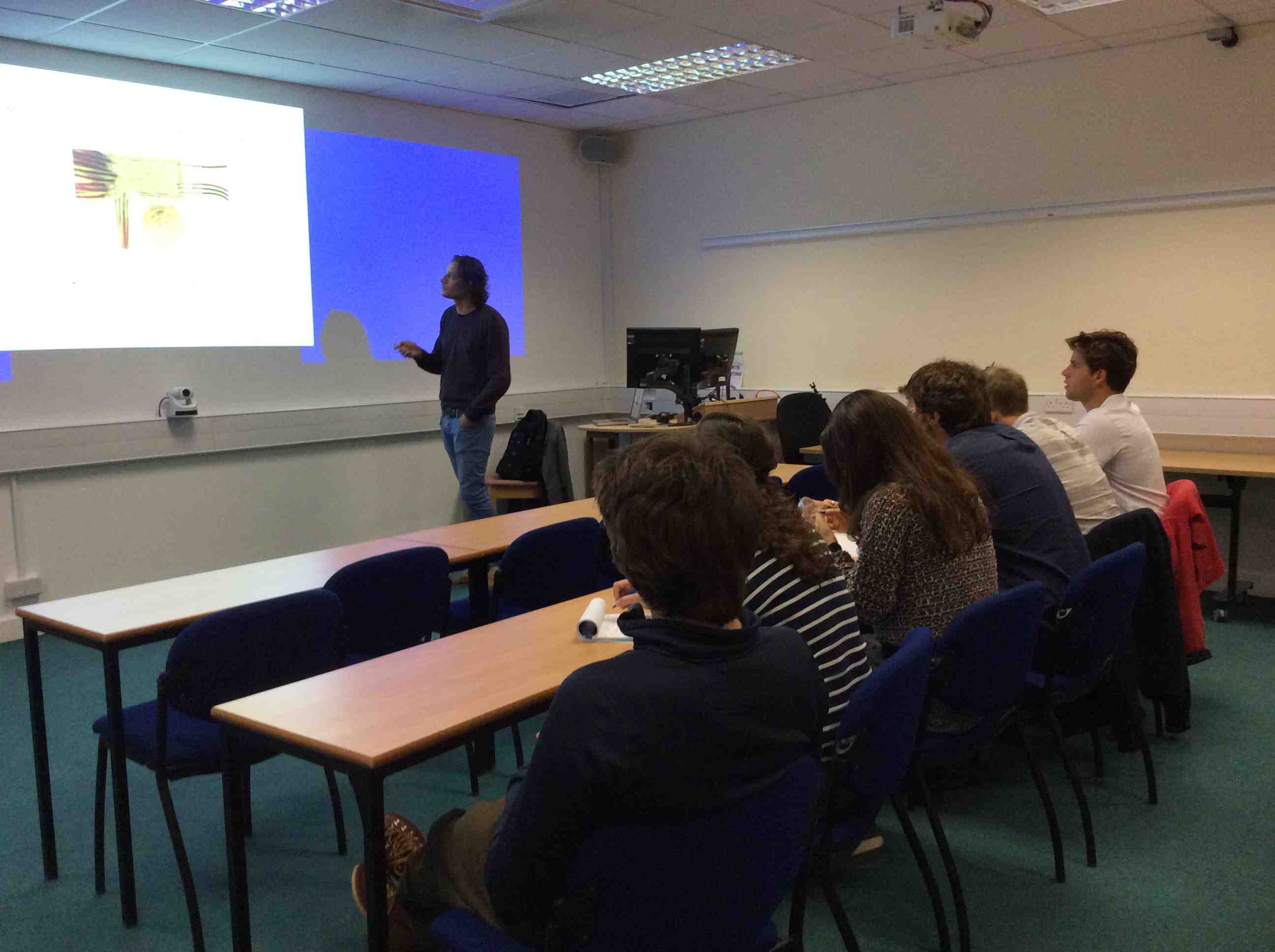
Today, we hosted the first half of this year’s  cohort of new Ph.D. student from the SynBio CDT for a chat about microfluidics. The students had a varied background (physics, chemistry, biology) but were all equally enthusiastic! We started with a presentation on microfluidics by Raphael, before heading down to the wetlab
 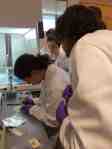 where we saw how to cut and bond a PDMS microfluidic channel onto a glass coverslip. Then the students took turns to cut a piece of glass capillary onto a microscope slide and filled it with a suspension of swimming algae (Chlamydomonas).
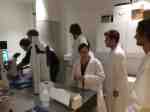
The group then moved to the microscopy room to observe the algae and record a movie of their motion. Finally, they tried to  make the computer recognise the position of the microorganisms in their movies using a particle tracking Matlab code. They actually managed to do it quite well! Well done everybody!!
SynBio CDT Teaser week
Next week we will help with the teaser week for the first intake of Ph.D. students of the new SynBio CDT co-sponsored by EPSRC and BBSRC in Warwick/Bristol/Oxford. We are organising two sessions on microfluidics, on Wed 24th and Thu 25th, with hands-on practicals in the lab. Watch this space for pics and comments!
Raphäel Jeanneret to join the lab in September
We’re all very excited that Raphäel Jeanneret decided to join the lab as a Postdoctoral Research Associate. He will arrive in September from Denis Bartolo‘s lab at ENS Lyon (actually they just moved from ESPCI….).
Looking forward to working together Raphäel!
Eukaryotic flagella synchronise through hydrodynamics

Article published on eLife. See also accompanying Insight by B. Friederich and I. Riedel-Kruse.
After many years working on Chlamydomonas, we finally graduated to multiple cells… But from a different organism: Volvox carteri. This multicellular relative of Chlamy has thousands of biflagellate somatic cells on its surface, which can be easily extracted from the colony and keep on beating for several hours. We grabbed two with independent micropipettes and showed that below a critical separation, the cells synchronise their beating. Synchronisation has a purely hydrodynamic origin. At the same time, their interaction changes the waveform of their flagella. Flagellar elasticity cooperates with hydrodynamic stresses to generate synchrony as predicted a few years ago!
 Polin Lab