Great news! Together with my friend (and host) Douglas Brumley, we have been awarded an Albert Shimmins International Fellowship from the University of Melbourne (AUD 15k) to help fund my 2-months visit to the Mathematics Department in Melbourne!
Author: mpolin
Ph.D. Opening
A Ph.D. studentship is available to join our group at Warwick! The project is a collaboration with Idan Tuval (IMEDEA, Spain) and Giorgio Volpe (UCL, UK). It will focus on dynamics and control of active matter suspensions, with a large experimental component (but most likely also some modelling/numerical simulations). To know more see here, and send us an email!
Iago @ IFF Spring School
Iago has been awarded a Flexible Training Award (£690) from the MRC IBR DTP to fund his participation to the IFF Spring School 2018. Well done Iago!
Dr. Matteo Contino
Matteo had a great Ph.D. viva yesterday, and is finally Dr. Contino! (Ok, he still has some minor corrections… but still). He will now move to Oxford to work for a spin-off of the University of Oxford.
Well done Matteo and good luck for the future!
Visit to U. Melbourne!
It’s always nice to start the week with some good news. Today I just heard from my good friend Douglas Brumley that the travel grant application we submitted was successful!! This will allow me & rest of the family to move to Melbourne for 6-8 weeks to work with Doug and an amazing array of other people at U. Melbourne. We still need to work out the details but I’m already very excited!!
Thesis submitted!
Congrats to Matteo Contino for turning in his thesis on “Characterisation and control of the dynamical properties of swimming microorganisms under confinement”!
Chlamydomonas Phototaxis: turn and what?
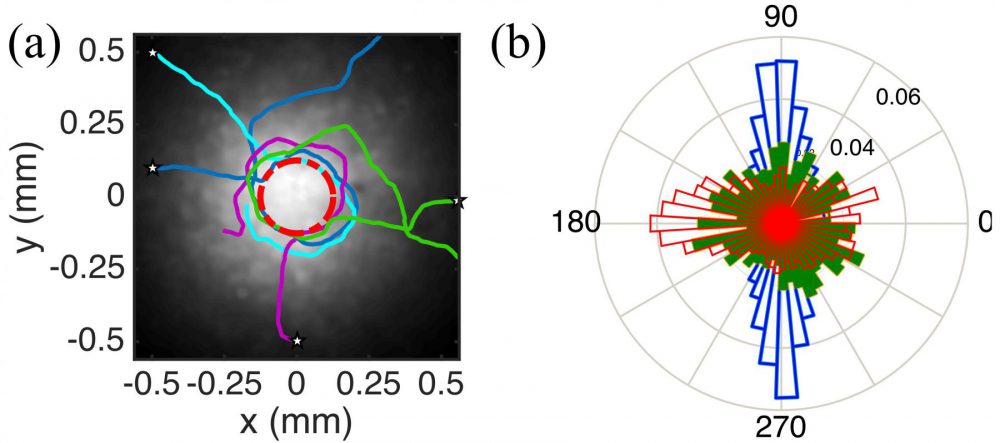 Phototaxis is one of the main categories of motility regulation by microorganisms. Arguably, it is particularly important for motile micro algae, due to their photosynthetic activity. One of the organisms where it has been studied the most is our beloved micro alga Chlamydomonas reinhardtii. Currently, we have a pretty good idea of the mechanism leading the cells to reorient towards/away from the light, but not much is known about what happens after they’ve reoriented…. In our recent paper we start looking into this, with surprising results.
Julia going back
We had the great pleasure to host for two months Julia Dolger, PhD student from the group of Anders Andersen and Thomas Kiorboe at the Technical University of Denmark. She’s been working very hard during her short stay here on a joint project looking at microbial predator/prey systems, and we had lots of interesting discussions! Good luck to her for the final part of her PhD and let’s keep in touch!
WBMi
Warwick’s Institute of Advanced Studies has granted us a small grant to kickstart a new interdepartmental network on microfluidics for life sciences and medical applications. This marks the birth of Warwick Biological MicroFluidics (WBMi): watch this space over the next months for developments!
Phase Defects

Does a stronger interaction always make for a more stable system? Certainly not for synchronising oscillators, as we show in a paper just accepted in Physical Review Fluids. There we study the behaviour of a strip of colloidal rotors as the system is lifted from a no-slip surface. As the hydrodynamic coupling strengthens, the system develop recurring phase defects which worsen its synchronisation. Our simulations show that defects result from a competition between short-range and long-range coupling. The paper is currently accessible through the ArXiv.
Update: The paper has been published (open access) and is now available here.
 Polin Lab